Designing an AI health assistant to help patients commit to treatment
A prescription digital therapeutic delivers treatment as a fixed sequence of lessons. Patients who fell behind rarely came back. I designed an adaptive content layer that responds to what each patient reports and rebuilt the session experience around it across 33 screens.
My Role
Designer
Direction, flows, visual system, and both rounds of testing
Team
3
UX researcher Intern,
Front-end Engineer Intern,
Design Manager
Duration
3 months
Research through final prototype and handoff
Tools
Figma
Miro board, Figjam, and Notion for brainstorming & user design
Project Summary
PROCESS
Changing the delivery instead of content
Interviews pointed to fatigue, skimming and low trust. Two rounds of testing shaped an AI guide and a read-aloud mode that stay within clinical and regulatory rules.
OUTCOME
Lessons that feel personal & supportive
Comprehension scores rose 25%, usability scores rose 29%, and 7 in 10 patients found the chatbot helpful.
PROBLEM
Identical treatment for different patients
Nearly half of patients dropped off by week four. Lessons were long, text-heavy and identical for everyone, and the content itself couldn't change.
01
Challenge
How do we design to increase longterm engagement?
Instead of in-person therapies, Click Therapeutics offers a modern, digital approach to mental health treatment. The company collaborates with psychiatrists to develop FDA-authorized prescription digital therapeutics that clinicians can prescribe to patients. While each condition is treated through its own dedicated app, all of Click Therapeutics' products follow the same evidence-based treatment framework.
During user research, they found that with six months of anonymized usage data across ~10K patients, a 48% drop-off occurred by the fourth week of usage. When questioned about why patients disengage from apps, they often heard that the content is, repetitive, complex & hard to digest. The experience sometimes feels emotionally disconnected. For Click, engagement isn't just a growth metric, but rather an incredibly important marker for the effectiveness of the patient's treatment.
I joined Click as a UX Design Intern to help reimagine how patients engage with therapeutic content. My primary focus was designing a flexible feature that could be implemented across all of Click's apps.
DESIGN GOAL
How might we deliver therapeutic content that feels clear, adaptive, and trustworthy across diverse patients, without changing the content?
02
Research
Patients struggle with commiting long term to digital treatment
Throughout interviews, we learn therapeutic content was one-size-fits-all, but patients are not. Lessons were long and text-heavy, which put off patients with low tech literacy, limited attention or sensory sensitivities.

PAIN POINTS
01
Too much reading
When facing dense content, patients fatigued & skimmed lessons.
02
Difficult to trust
Many patients, especially those that suffer from schizophrenia, have a hard time trusting what they read.
"Patients feel overwhelmed or tired when there are long walls of text"
- Stakeholder 4
Throughout interviews, we learn therapeutic content was one-size-fits-all, but patients are not. Lessons were long and text-heavy, which put off patients with low tech literacy, limited attention or sensory sensitivities.
KEY TAKEAWAY
How might we deliver therapeutic content that feels clear, adaptive, and trustworthy across diverse patients, without changing the content?
03
Building a solution
How do we enforce a AI in a safe, non-invasive manner that helps patients understand lessons?
We decided the AI chatbot would close the gap between static content and active engagement by giving patients a “guide” they can trust and return to, reinforcing comprehension and promoting continuous interaction with therapeutic material, mimicking the way a professional therapist or mental health professional may guide a patient through their own thoughts.
However, we must toe the line carefully. Similar to how AI chatbots are not qualified to give medical advice, it is not qualified to safely cultivate professional relationships or give mental health advice to patients.
To enforce this, I work with engineers to produce a guidelines for what the chatbot may or may not do, as well as limiting the input from patients to apply guardrails that may derail the AI.
GUIDELINES
MAY
Suggest or reorder lessons based on patient preference
Review or summarize previously learnt content
Give examples based on lesson content
Rewrite or rephrase lesson content
Suggest which exercise to try next
MAY NEVER
Author or alter a clinical instruction
Skip a required module
Interpret a symptom or offer a prognosis
Respond to risk language in its own words
Speak in the voice of the care team
04
Solution
Lessons that guide, read aloud, and adapt to every patient
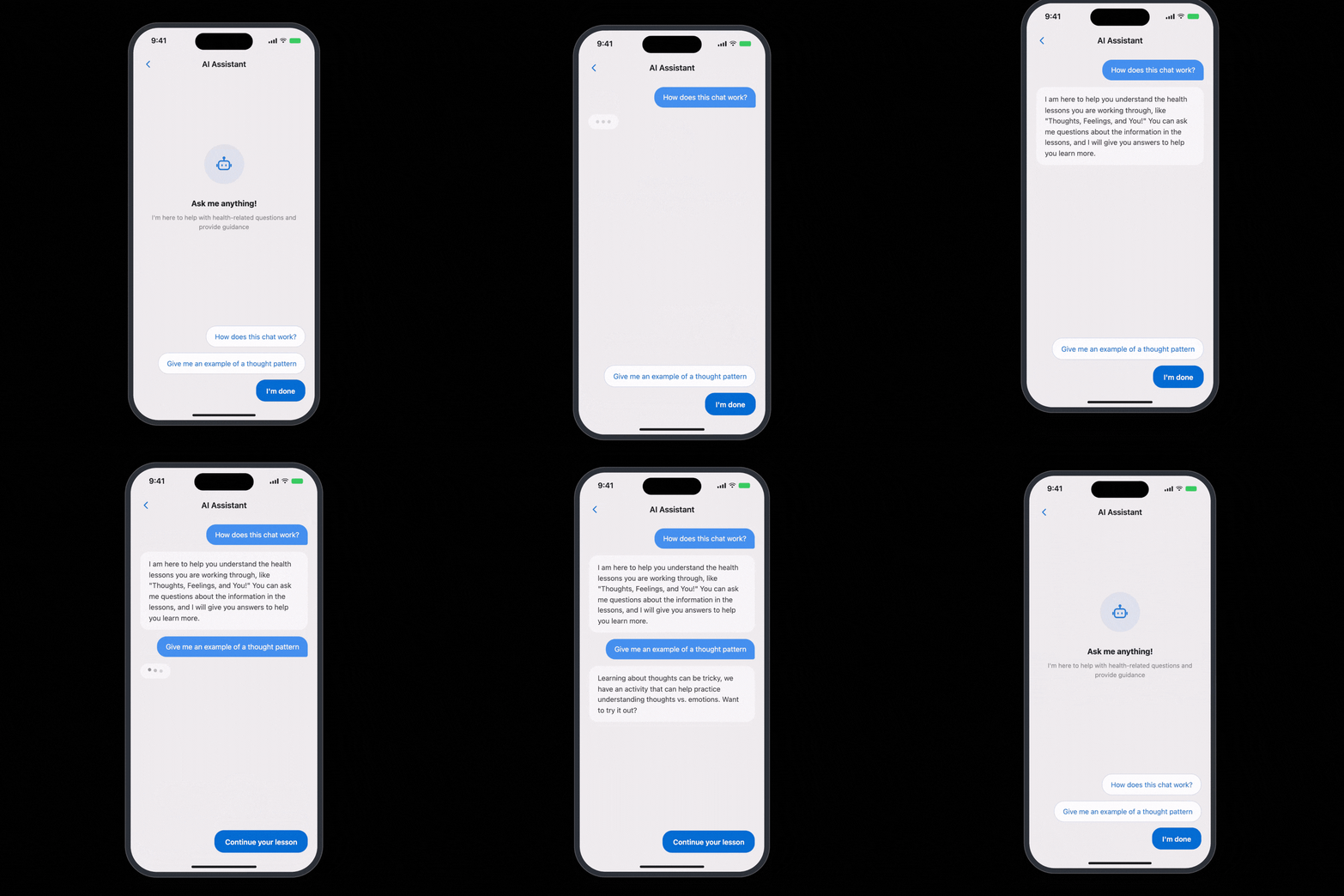
An AI guide to support and guide patient through lessons
Designed to provide guidance and clarity throughout the lesson, the AI assistant helps patients better understand and stay engaged with the content.
At any point during the lesson, patients can interact with the chatbot to ask questions, request clarifications, or see examples related to the concepts being taught.
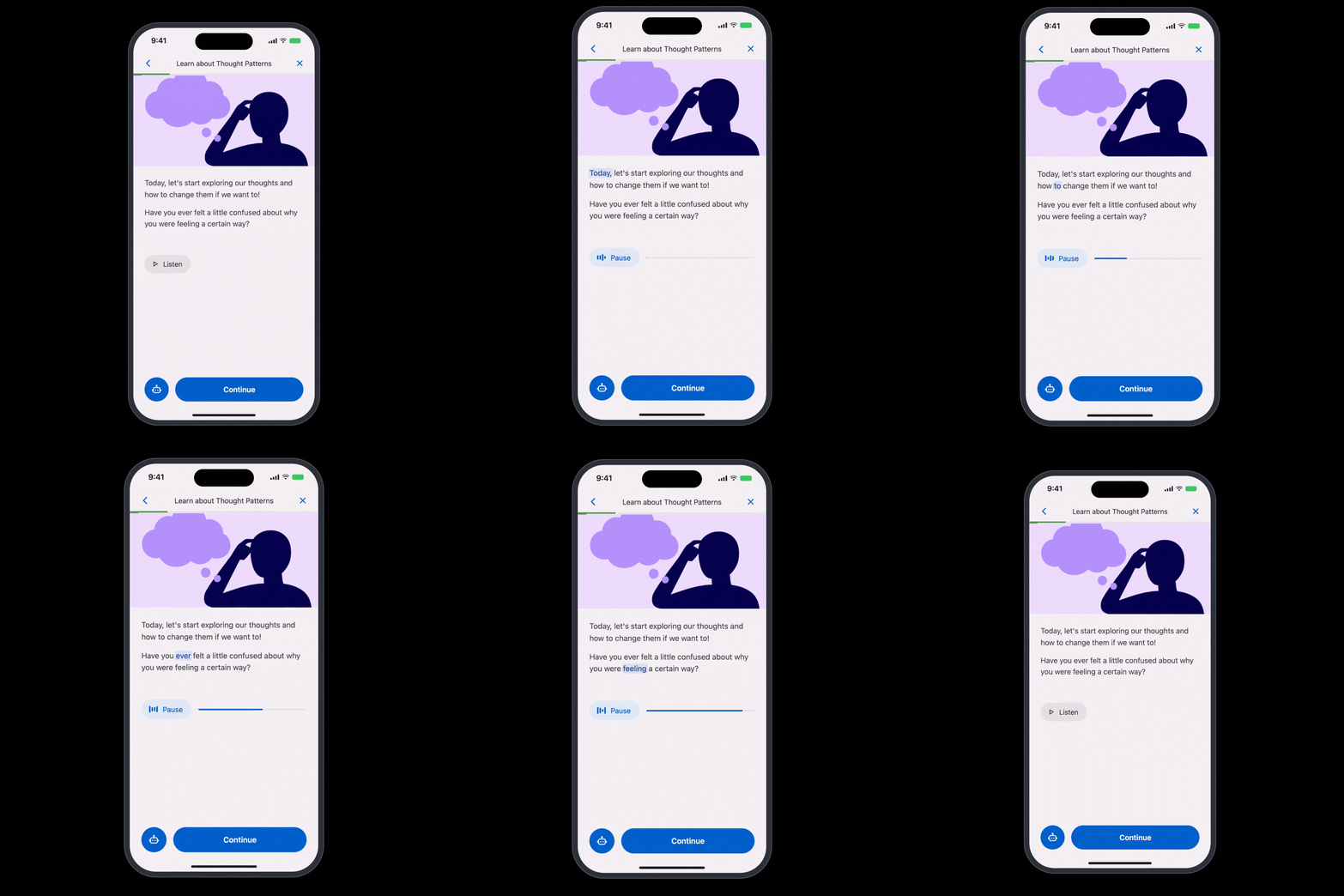
Read aloud and highlighting features to support accessbility
A listening option provides an alternative to dense or text-heavy content that causes disengagement, supports patients who prefer passive learning modes, and builds therapeutic trust through emotionally attuned voice guidance.
A read-aloud feature designed to improve accessibility and support comprehension by offering patients an alternative way to engage with lesson content.
By activating the button, patients can listen to the material instead of reading it, which benefits users with visual impairments, reading difficulties, or different learning preferences.
05
Results
Patients felt supported & engaged during lessons, without any changes to underlying content
The content didn't change, but the way patients engaged with it did. Using pre- and post-lesson quizzes and feature ratings, we found that the conversational format helped patients retain more information and feel more confident moving through each lesson.
25%
increase in comprehension scores
29%
increase in usability scores
7/10
of users found
the chatbot helpful
"It feels less like homework now, and more like a conversation."
- Participant 1, Round 2
06
Reflection
Constraints can sharpen the design
This project taught me that in healthcare, good design often means working within constraints rather than around them. I couldn't rewrite the content, because the content is the treatment. So I focused on how it was delivered. Turning lessons into a conversation gave patients a low-pressure way to ask questions and check their understanding, which mattered because many were hesitant to admit when they were confused. It also changed how I think about success.
Finishing a lesson isn't the same as understanding it, so I learned to measure comprehension directly instead of relying on completion. Early results were promising, but real adherence plays out over weeks, not a single session. That's why long-term retention is the next thing I'd want to study.
View my other work


Let's build something awesome :)